
Papua New Guinea
| COMING SOON
The work we are beginning to develop in Papua New Guinea is allowing us to learn firsthand about the fragility and value of the Coral Triangle, one of the most biodiverse regions on the planet.
From this initial link, we hope to collaborate with local communities on reef restoration, the participatory development of new Marine Protected Areas, the monitoring of their waters by local guardians, and a bridge for their artisanal work to reach new markets.
Our goal is to support and amplify the work that already exists in the territory, while also showcasing the culture and way of life of those who live there.
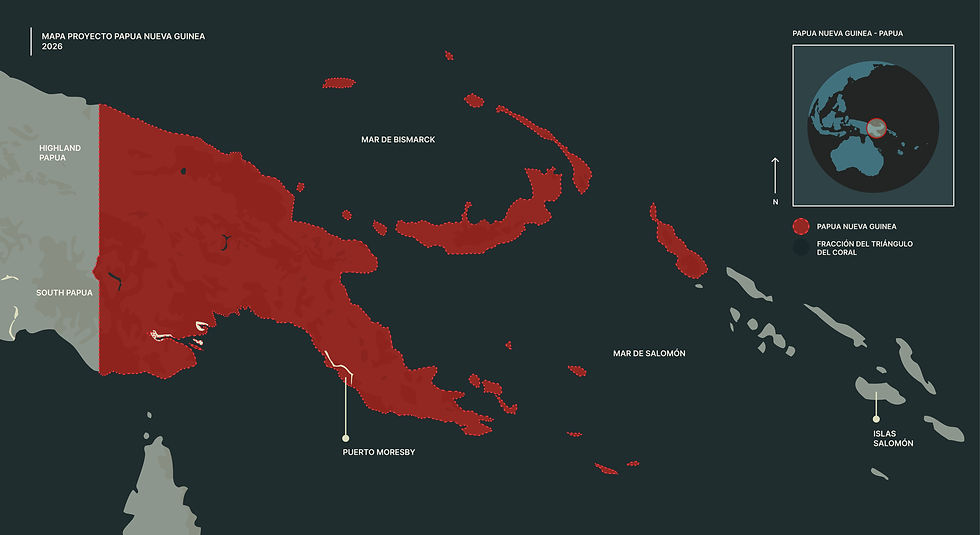
In Papua New Guinea, there are regions that remain isolated and pristine, where the way of life and culture of their communities are largely the same as those of their ancestors. They fish from canoes, build their houses with woven palm leaves, and organize their day according to the sun, the tides, and the seasons.
That balance is threatened today.
Technology and globalization are encroaching upon customs that remained unchanged for generations. And what is least visible at first glance is also the most fragile: the coral reefs upon which all that life depends.
WHY PAPUA NEW GUINEA
The waters of Papua New Guinea are part of the Coral Triangle, the region with the greatest marine diversity on the planet.
Coral reefs are more than just scenery: they act as a natural barrier against waves, support the fishing that sustains local communities, capture carbon, and are the foundation of a tourism industry that also depends on healthy oceans. Without them, the entire ecosystem collapses.
Today they face warming waters, increasing acidity, rising sea levels, and fishing practices that directly harm them. The results are already visible: bleached corals, declining biodiversity, islands losing their coastlines, and others that have disappeared.


